Brotherhood in the Age of Individualism
We are the most connected generation in human history. The average smartphone user has hundreds of contacts, thousands of followers, and access to more human communication than any previous generation could have imagined. We are also, according to a growing body of research, among the loneliest.
The paradox is real and documented. Loneliness in the developed world has reached levels that public health authorities now describe as epidemic. Young men, in particular, report declining numbers of close friendships — people they could call in a crisis, people who know them well enough to challenge them honestly. The connections we accumulate online are wide but shallow; the bonds that sustain a life are narrow but deep.
What genuine brotherhood requires
Brotherhood — real brotherhood, not the social media variety — requires things that the digital world cannot provide. It requires physical presence: the experience of being in the same room with another person, of reading their face and their posture as well as their words. It requires time: the accumulation of shared experience over years and decades, the trust that can only be built through repeated encounters in varied circumstances.
It requires, above all, commitment: the willingness to show up, not only when it is convenient, but when it is not. To be present for the friend whose marriage is failing and whose company is not, at that moment, enjoyable. To say the difficult thing rather than the comfortable one. To hold someone to account because you care about them, not because you enjoy the feeling of superiority.
What the lodge provides
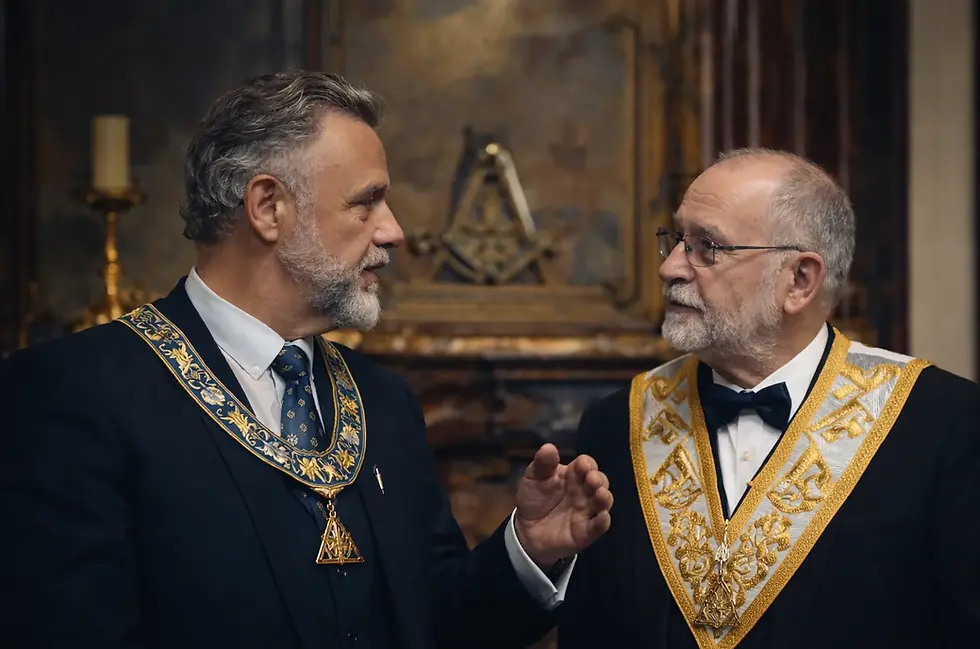
The Masonic lodge is, in its way, a school of this kind of brotherhood. It assembles men who might never have met in the ordinary course of life and asks them to treat each other as brothers — not as acquaintances, not as colleagues, but as brothers, with everything that word implies. It does this not through sentiment but through structure: through the repeated shared experience of ritual, through the mutual obligations of membership, through the practical demands of lodge governance.
None of this produces genuine brotherhood automatically. Brotherhood is an achievement, not a given; it must be built, over time, through the choices that its members make. But the lodge provides conditions in which genuine brotherhood becomes possible — and models, in the older and more experienced members, what it looks like when it is achieved.
The limits of individualism
The culture of individualism that has dominated Western life for the past half-century has produced real goods: expanded personal freedom, the dismantling of suffocating social hierarchies, the liberation of millions from expectations and constraints that had nothing to do with who they actually were. These are genuine achievements that should not be minimised.
But individualism, taken to its extreme, produces a kind of hollowness. The self, cut loose from the commitments and communities that give it definition, becomes strangely weightless. Freedom without obligation is not liberation: it is loneliness with good branding. The man who belongs to nothing and is accountable to no one has not achieved independence; he has achieved isolation.
The recovery of belonging
What the Masonic tradition offers — and what many men who join it report finding, often to their surprise — is a sense of belonging that is genuine rather than performative. The brotherhood is real: it involves real obligations, real meetings, real conversations, real mutual support. It is not a lifestyle brand or a social identity; it is a commitment that makes demands and delivers returns in proportion to what is invested.
In an age of individualism, the recovery of genuine belonging is not a retreat from modernity. It is the recognition that the human being is, as Aristotle observed, a social animal — that we are most fully ourselves not in isolation but in genuine community. Freemasonry, at its best, is a place where that recognition is not just theorised but practised.


Comments